Every Tuesday at Soaring Eagle is herd health day. Each week our vet, Dr. Jeff Bleck of Dairy Doctors in Plymouth, WI stops by about 8 am. He's usually on the farm for about 2 hours and most of his time is spent checking cows to determine if they are pregnant. Here is a video and explanation of how that works:
So about 35 days after the cow is inseminated, she is checked for the first time to determine if she is pregnant or not. During this time we can tell if she is having twins which happens in about 4% of cow pregnancies. Then 30 days later we check her for a second time. At this second check, Jeff is actually able to tell us if its a heifer calf or a bull calf. He also checks all our cows before breeding them for the first time to make sure they are in good condition for breeding. If a cow has a difficult time transitioning to a milk cow, we may wait a bit longer before beginning a breeding program on her. In the video below, Jeff is checking more cows and we show you what he sees on the eye piece that he's wearing:
On this particular day we checked 30 cows, of which, 24 were confirmed pregnant. We have a deal with Jeff that if we hit 75% on any given week, he buys us lunch. Up until this day, that's only happened once! Since 24 of 30 is 80% it looks like we'll be going for lunch again soon! Now he wants to raise the goal for us however, but I guess that called continuous improvement!!
There has been much discussion in our industry regarding our need to keep up with the food needs of our growing planet. You see, by the year 2050, we will need 100% more food and it has been determined that 70% of this increase must come from technology and improved efficiencies. Since I truly believe that food is a basic human right for ALL people, we must continue to find new practices, products and genetics to meet this need. More information regarding this can be obtained by watching the following video (Click on link that follows):
There has been much controversy regarding the use of genetically modified seed and the use of rBGH in dairy cows. These are both examples of technology that allow us to produce more with fewer resources and with a smaller carbon footprint. It infuriates me that as a consumer I no longer have a choice in the grocery store to buy milk produced on farms that choose to use rBGH! The Food and Drug Administration, World Health Organization, American Medical Association, American Dietetics Association, and the National Institute of Health have independently confirmed that dairy products and meat from BST treated cows is safe for human consumption. It's use allows us to produce every gallon of milk with less land, feed and water! As consumers, this means that we pay a higher price for milk in the grocery store and I worry that for some it means that milk gets removed from the grocery list and is replaced with soda or Kool Aide.
If you believe that having a choice in the grocery store is the right thing, the next time you are there ask them to carry milk that is produced using a safe, proven technology which will keep more money in your pocket. You see, consumers can not buy milk which is "rBGH free" - since this is naturally found in cows milk. For those who choose to buy milk produced without this technology, I ask that you too consider standing up for the rest of us who do not have a choice and ask your grocer to carry both.
This year the annual St. Patrick's Day parade will be held in Manitowoc along 8th Street on Friday, March 16th at 6:30 pm., with fireworks to follow. Be sure to get there early to get a good spot along the route. Last year, the picture below was taken of our float and while we decided to take this year off, several of us plan to be there as observers.
The following is our wish for all our friends, family and followers. It is an Irish Blessing that is dear to our hearts.
We know that we are part of a very dangerous industry. In fact, farming is number four on the list behind fishermen, loggers and pilots. There were 300 farm related fatalities in the US in 2010. While we take great measures to make sure everyone of us is safe, after this week, we also are more prepared should something happen.
On Wednesday, 11 of our family members and key employees from each shift participated in First Aid and CPR training right at the farm. We packed into our conference room and with instruction from Tammy of Valders Ambulance Service and Judy of Holy Family Hospital, we all obtained certification for Adult and Infant CPR and First Aid. While we sure hope we never have to use it, we all feel better prepared should something happen either at the farm or with our families. Several of those in attendance have young children and all felt better knowing the proper way to handle choking - no it's not a smack on the back.
Here are some pictures of us working on our CPR:
CPR and First Aid are offered at most Red Cross locations, hospitals and many churches. I encourage everyone to find time to take a course. Someday you may be glad you did!!!
Twice each year, every cow at Soaring Eagle Dairy gets her hooves trimmed by a specialist. Don Vosters of Vosters Hoof Care comes to the farm three times monthly, each time seeing 55 - 85 cows and trimming their hooves to provide the cow with proper balance and weight distribution on those feet and legs. The attached video shows the process.
The tool that Don is using is a special grinding wheel and while it is very loud, it's really not a lot different than the Dremel type tool that is used at the spa on ladies who get their finger or toe nails done. While human trips to the spa for this type of work is mostly driven by vanity, for the cows taking good care of their feet is extremely important in maintaining her overall health. You see if a cow has a sore foot, she will not spend the time she should at the feed bunk or the water tank, meaning she will not be meeting her energy and nutrient requirements.
Here's another video with some close up shots of the work that's done.
Perhaps we could start painting those hooves with OPI polish in colors like "Moolishus Mocha" or "Udderly Orange"!!
Last month I had the opportunity for the third time to travel to Fair Oaks, Indiana to visit the Fairy Oaks Dairy Adventure Center. For anyone looking for something to do for entertainment as well as to have all your questions about dairy farming today answered, I highly recommend a trip there. You can find out more at www.fofarms.com. The following is a brief description of what we all did and saw.
The Dairy Tour
Upon entering the Dairy Adventure Center, visitors quickly come to a school bus like this to take a tour of one of the dairies 3000 cow farms. The tour bus drives you through one of the cow barns, past the feed center and new babies (below).
This is the front of the milking center which houses the 72 cow carousal parlor. Along side this building is the specially built garage which the bus pulls in and visitors can then proceed up one floor to the observation deck and watch the milking in the parlor.
Once inside, you not only get to watch the cows being milked, but you also learn a lot from the video which tells you about the milking process. Click on the picture below to watch the video. Turn your speakers up - the narrative on the video is hard to hear, but the subtitles have lots of information.
The Education Center
For me the highlight of the education center was the 4D video that we watched. Very informative and entertaining. Just watch out when the cow sneezes!! Below are other parts of the center.
The above is an exhibit that contrasts farming back in the "old days" to farming today which uses technology to improve cow comfort as well as improve milk quality and production.
This is a merry-go-round of Holsteins
At this station visitors can time themselves prepping a cow and attaching the milk machine.
This is a fun and interactive climbing wall for kids.
Hall of Holsteins, each of which has some great facts to learn more about cows and dairy.
The Birthing Barn
Located just outside this barn is a stop and go light. A red light means there's not much happening inside, but a yellow light means a cow is in labor and a green light means the calf is on it's way.
On the day of our visit, we just missed the first calf on the right being born, but we able to watch the delivery of the calf on the left.
The Visitor Center
As if all the above wasn't enough, they also have a visitor center with souvenirs, a cheese store, a deli and ice cream shop. We had soup and a sandwich along with milk shakes that were the best! I brought home some of the Fair Oaks brand 5 year Cheddar which was amazing too! This is a must see and a dream of mine is to build something like this in Manitowoc County. I'm happy to report a group is working right now to determine the feasibility of something similar in our state! That will take time, so again, if you are looking for a nice getaway, I highly recommend a trip to Indiana!
When a group of cows goes up to the parlor for milking, at the start of the group there are about 125 cows in the area we call the holding area. Each time a side of cows leaves the parlor another 16 cows proceed from the holding area into the parlor and so the amount of space these cows need to be held in is constantly getting smaller and smaller. To manage this area, we use a crowd gate which slides on rails along this area, gradually decreasing in size the holding area and moving the cows up toward the parlor.
Well after 15 years, the crowd gate had begun to cause us a lot of troubles and we decided that it was time to replace it. No big deal, right? We just write a check, take the old one out and put the new one in. Sounds simple - oh but it was far from simple. The 3 days it took us to get this done each started by 7 am and we quit about 6:30 pm each night. You see what makes this less than simple is the fact we need to keep milking cows and since each shift takes 7 hours and 45 minutes from start to clean up, there isn't a lot of time to work without having to manage around the cows. Here are some pictures of our project:
This is our old crowd gate which at one point we had to work on about 8 different times in a period of 6 weeks - it was really time to make this upgrade!!
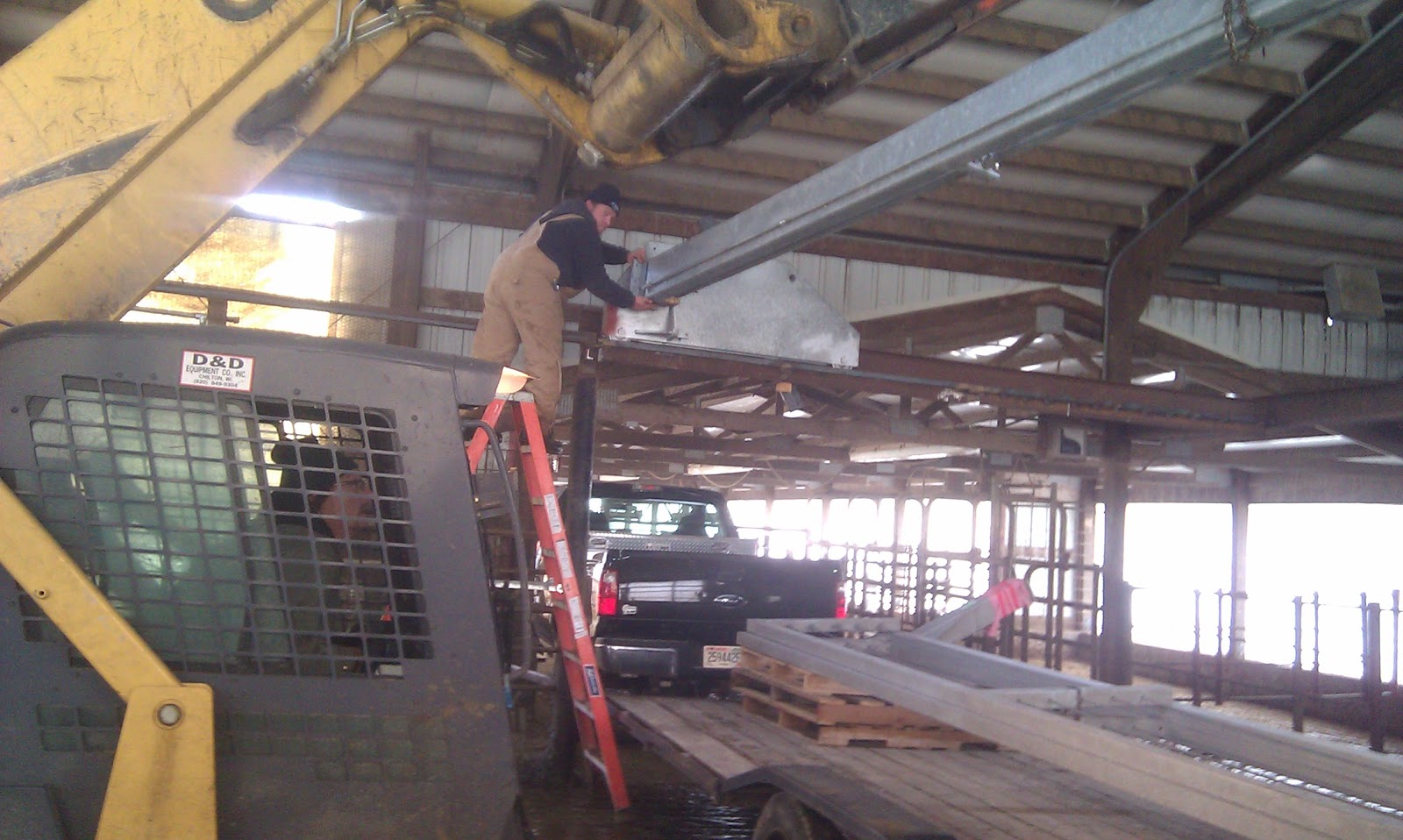
The new crowd gate was loaded from a trailer that we had to back it into the barns about 700 feet to the holding area. We used this skid steer with forks to lift the frame off the trailer and then assemble it up on the tracks. We did most of the work on the new gate in the back end of the holding area to allow us to continue to used the old gate in the area up by the parlor.
The skid steer holding the frame in place while being attached to the brackets that ride along the track.
Work being done to replace the rails while cows are still being milked. It sure would have been nice if the rails that the gate rides on would have worked for the new gate. Replacing these took lots of time and lots of grinding and welding, neither of which the cows are really comfortable with.
Removal of the old gate. This was tricky because the gate itself was wider than the holding area. We had to lift it, shift it slightly so it was crooked. And then maneuver it to the back of the holding area and take it out on the trailer like we brought ht new gate in.
Temporarilyhow we moved cows, yes I WAS the crowd gate for a few days!!
The new crowd gate in operation!! Like most thing in life, it was a challenging three days but oh so worth it in the end.