There are a bunch of things we do at the farm to transition from the cold months to warm months of Wisconsin. During the cold months, we have a heater in the water tanks to keep water from freezing - these get turned off. Additionally, we have a fan and water sprinkler system in all the barns that keeps the cows cool in summer. These must all be gone through to make sure they are working properly.
We also spend a day digging the sand out of the beds the cows lay in. While each cow's bed gets groomed three times per day, removing any cow pies, deep down in the pile is a great place from bacteria to hang out. As a result each spring before the weather gets warm (which would cause those bacteria to really get going), we dig the sand out. The attached video shows the "plow" our shop guys built for on the back of the oldest tractor we have that cleans out 95% of the beds on the farm. (Yup, that's a plow blade from an old mole board plow which is used to work up ground in the fall after harvest.)
My brother-in-law Jeremy is operating the tractor and plow
The 5% of the sand that the plow doesn't get we get the old fashion way...shovel and "girl power". It's interesting to note that because sand in an inorganic substance, the sand we take out just gets piled for several months. Because there in no inoranic material to feed the bacteria, they eventually die off and we can test for bacteria and reuse a few months later.
I have to admit that when my younger brother started back at the farm, I thought perhaps the "Head Rock Picker" title would be passed on to him. He is in his 20's and I am in my 40's...
I must have done a pretty good job over the years since they never reassign these duties. Don't get me wrong, I get LOTS of help. Luckily I have Mom to help with the tractor driving, Stacy and Kelly help out too and now are kids are getting to the age of actually being helpful and productive. They are also beginning to appreciate a little money in their pockets and that is a great motivator.
We finished picking rocks on the 150 acres of alfalfa a couple weeks ago when we had some warm and dry weather. This is usually the worst part of rock picking. We need to pick all rocks bigger than a baseball. On one 28 acre field this amounted to 3 wagon loads full. On these fields we sometimes spend more time bent over than actually walking. Makes for a long, tough day. It was great to have this wrapped up by the middle of April since last year we didn't finish until June - this springs weather has been so productive!
This past Friday, we started on our corn ground. We have about 850 acres of corn ground to cover, but the good news here is we don't have to pick anything smaller than a cantaloupe. Today we covered 70 acres of corn ground on in 3 1/2 hours. The fields we picked today however had some HUGE rocks in that needed to be moved before we could get in to work the ground. So Kelly and I headed out and quickly ran over about 100 acres to remove the "big ones". These two pictures show what we managed to accomplish in about an hour and a half.
The front half of the wagon...
The other half of our harvest. Notice the handle and shovel head amid the big rocks for perspective.
Not only do we have the pride of knowing we managed to get all those bad boys on the wagon by ourselves, I also managed to find a gorgeous new rock for my flower bed. Now I'm off to get some aspirin...
So as many of you know we don't have any bulls on our farm. All cows are bred by artificial insemination, using semen harvested from bulls. By doing so, we control the genetics of our herd to a certain degree. You see, if a cow has a good udder and good feet, but perhaps her milk production is less than our average, we can breed her to a bull that has proven to provide daughters that have good milk production. Conversely, if we have cow that milks like a rock star, but looks like she has a hard time on her feet and legs, we can choose a semen from a bull that will help her daughter improve that trait.
A straw of semen can range from $15 to $100. That's a pretty big range, however when you consider the lower cost bulls are "not proven" and the higher cost bulls perhaps provide some pretty strong daughters, it makes sense. Bulls are ranked on 30+ traits - everything from udder, feet, legs, milk production, somatic cell count, ease of calving...the list is huge!
The week of March 19th, we had a bit of "bull stuff" going on - even though we have no bulls on the farm. We were contacted by Select Sires - the company we buy our semen from - to ask if we would allow them to come and take a picture of three of our cows. These are daughters of young sires that they were trying to prove in hopes that these bulls would make it into the 2012 bull book. So these three girls were given a good hair cut on Tuesday, and Wednesday morning they got a bath. Then later in the day about 6 people showed up to get them all in the right position to be pictured for future marketing. Here are the three girls they were interested in:
I admit these are some pretty nice looking cows, but the level of particularity that these guys taking pictures had was phenomenal. You see the cows legs each had to be placed a certain way, and if the cow moved even just one inch, they had to move her back into place. The last girl was particularly challenging - as soon as they had her in place and the folks helping moved out of the way, she would shift before the picture could be taken and then they'd have to start over. Then things got funny. You see Dale Sabo, of Select Sires, placed this drape over his head and crawled around on the ground making bellering sounds to distract the cow...which while it looked ridiculous - it worked. The cow stood perfectly still when she saw this:
Finally, it's interesting to note that we now have technology in place to use semen from a bull that is 90% certain to produce a heifer calf. Semen can be sorted based on sex of the off spring. This is often used by dairies interested in growing to allow them to fill barns using their own cows rather than purchasing from the outside. Another example of the technology that makes our industry so interesting!
My previous posts point out that there are 3 of us girls at Soaring Eagle Dairy farming with our parents. We are so excited that another member of the family is also back on the farm joining us. My brother Nick graduated from UW-Milwaukee with a business and marketing degree and has worked for about 5 years at Acuity Insurance in Sheboygan as an underwriter. While that was a GREAT place to work, something has pulled him back to the farm. Perhaps it's the thought of spending countless hours with his sisters every week!!
Since it's hard to beleive anyone would trade in a job with the countless gifts Nick received at his previous employer (gift cards, the most AMAZING gift basket at Christmas, beer served with lunch on Brewer's opening day, pumpkins in fall, strawberries in summer, Packer hat when they won the Super Bowl - the list goes on....), I thought some may enjoy seeing Nick in action at Soaring Eagle. Here's a few shots....
My favorite of these pictures is the last one. We are working on a project in our parlor and Nick is using a jack hammer to bust out some concrete. Now if I can only get a picture of him with some dirt (yes, I mean manure) on his clothes!!
Every Tuesday at Soaring Eagle is herd health day. Each week our vet, Dr. Jeff Bleck of Dairy Doctors in Plymouth, WI stops by about 8 am. He's usually on the farm for about 2 hours and most of his time is spent checking cows to determine if they are pregnant. Here is a video and explanation of how that works:
So about 35 days after the cow is inseminated, she is checked for the first time to determine if she is pregnant or not. During this time we can tell if she is having twins which happens in about 4% of cow pregnancies. Then 30 days later we check her for a second time. At this second check, Jeff is actually able to tell us if its a heifer calf or a bull calf. He also checks all our cows before breeding them for the first time to make sure they are in good condition for breeding. If a cow has a difficult time transitioning to a milk cow, we may wait a bit longer before beginning a breeding program on her. In the video below, Jeff is checking more cows and we show you what he sees on the eye piece that he's wearing:
On this particular day we checked 30 cows, of which, 24 were confirmed pregnant. We have a deal with Jeff that if we hit 75% on any given week, he buys us lunch. Up until this day, that's only happened once! Since 24 of 30 is 80% it looks like we'll be going for lunch again soon! Now he wants to raise the goal for us however, but I guess that called continuous improvement!!
There has been much discussion in our industry regarding our need to keep up with the food needs of our growing planet. You see, by the year 2050, we will need 100% more food and it has been determined that 70% of this increase must come from technology and improved efficiencies. Since I truly believe that food is a basic human right for ALL people, we must continue to find new practices, products and genetics to meet this need. More information regarding this can be obtained by watching the following video (Click on link that follows):
There has been much controversy regarding the use of genetically modified seed and the use of rBGH in dairy cows. These are both examples of technology that allow us to produce more with fewer resources and with a smaller carbon footprint. It infuriates me that as a consumer I no longer have a choice in the grocery store to buy milk produced on farms that choose to use rBGH! The Food and Drug Administration, World Health Organization, American Medical Association, American Dietetics Association, and the National Institute of Health have independently confirmed that dairy products and meat from BST treated cows is safe for human consumption. It's use allows us to produce every gallon of milk with less land, feed and water! As consumers, this means that we pay a higher price for milk in the grocery store and I worry that for some it means that milk gets removed from the grocery list and is replaced with soda or Kool Aide.
If you believe that having a choice in the grocery store is the right thing, the next time you are there ask them to carry milk that is produced using a safe, proven technology which will keep more money in your pocket. You see, consumers can not buy milk which is "rBGH free" - since this is naturally found in cows milk. For those who choose to buy milk produced without this technology, I ask that you too consider standing up for the rest of us who do not have a choice and ask your grocer to carry both.
This year the annual St. Patrick's Day parade will be held in Manitowoc along 8th Street on Friday, March 16th at 6:30 pm., with fireworks to follow. Be sure to get there early to get a good spot along the route. Last year, the picture below was taken of our float and while we decided to take this year off, several of us plan to be there as observers.
The following is our wish for all our friends, family and followers. It is an Irish Blessing that is dear to our hearts.
We know that we are part of a very dangerous industry. In fact, farming is number four on the list behind fishermen, loggers and pilots. There were 300 farm related fatalities in the US in 2010. While we take great measures to make sure everyone of us is safe, after this week, we also are more prepared should something happen.
On Wednesday, 11 of our family members and key employees from each shift participated in First Aid and CPR training right at the farm. We packed into our conference room and with instruction from Tammy of Valders Ambulance Service and Judy of Holy Family Hospital, we all obtained certification for Adult and Infant CPR and First Aid. While we sure hope we never have to use it, we all feel better prepared should something happen either at the farm or with our families. Several of those in attendance have young children and all felt better knowing the proper way to handle choking - no it's not a smack on the back.
Here are some pictures of us working on our CPR:
CPR and First Aid are offered at most Red Cross locations, hospitals and many churches. I encourage everyone to find time to take a course. Someday you may be glad you did!!!
Twice each year, every cow at Soaring Eagle Dairy gets her hooves trimmed by a specialist. Don Vosters of Vosters Hoof Care comes to the farm three times monthly, each time seeing 55 - 85 cows and trimming their hooves to provide the cow with proper balance and weight distribution on those feet and legs. The attached video shows the process.
The tool that Don is using is a special grinding wheel and while it is very loud, it's really not a lot different than the Dremel type tool that is used at the spa on ladies who get their finger or toe nails done. While human trips to the spa for this type of work is mostly driven by vanity, for the cows taking good care of their feet is extremely important in maintaining her overall health. You see if a cow has a sore foot, she will not spend the time she should at the feed bunk or the water tank, meaning she will not be meeting her energy and nutrient requirements.
Here's another video with some close up shots of the work that's done.
Perhaps we could start painting those hooves with OPI polish in colors like "Moolishus Mocha" or "Udderly Orange"!!
Last month I had the opportunity for the third time to travel to Fair Oaks, Indiana to visit the Fairy Oaks Dairy Adventure Center. For anyone looking for something to do for entertainment as well as to have all your questions about dairy farming today answered, I highly recommend a trip there. You can find out more at www.fofarms.com. The following is a brief description of what we all did and saw.
The Dairy Tour
Upon entering the Dairy Adventure Center, visitors quickly come to a school bus like this to take a tour of one of the dairies 3000 cow farms. The tour bus drives you through one of the cow barns, past the feed center and new babies (below).
This is the front of the milking center which houses the 72 cow carousal parlor. Along side this building is the specially built garage which the bus pulls in and visitors can then proceed up one floor to the observation deck and watch the milking in the parlor.
Once inside, you not only get to watch the cows being milked, but you also learn a lot from the video which tells you about the milking process. Click on the picture below to watch the video. Turn your speakers up - the narrative on the video is hard to hear, but the subtitles have lots of information.
The Education Center
For me the highlight of the education center was the 4D video that we watched. Very informative and entertaining. Just watch out when the cow sneezes!! Below are other parts of the center.
The above is an exhibit that contrasts farming back in the "old days" to farming today which uses technology to improve cow comfort as well as improve milk quality and production.
This is a merry-go-round of Holsteins
At this station visitors can time themselves prepping a cow and attaching the milk machine.
This is a fun and interactive climbing wall for kids.
Hall of Holsteins, each of which has some great facts to learn more about cows and dairy.
The Birthing Barn
Located just outside this barn is a stop and go light. A red light means there's not much happening inside, but a yellow light means a cow is in labor and a green light means the calf is on it's way.
On the day of our visit, we just missed the first calf on the right being born, but we able to watch the delivery of the calf on the left.
The Visitor Center
As if all the above wasn't enough, they also have a visitor center with souvenirs, a cheese store, a deli and ice cream shop. We had soup and a sandwich along with milk shakes that were the best! I brought home some of the Fair Oaks brand 5 year Cheddar which was amazing too! This is a must see and a dream of mine is to build something like this in Manitowoc County. I'm happy to report a group is working right now to determine the feasibility of something similar in our state! That will take time, so again, if you are looking for a nice getaway, I highly recommend a trip to Indiana!
When a group of cows goes up to the parlor for milking, at the start of the group there are about 125 cows in the area we call the holding area. Each time a side of cows leaves the parlor another 16 cows proceed from the holding area into the parlor and so the amount of space these cows need to be held in is constantly getting smaller and smaller. To manage this area, we use a crowd gate which slides on rails along this area, gradually decreasing in size the holding area and moving the cows up toward the parlor.
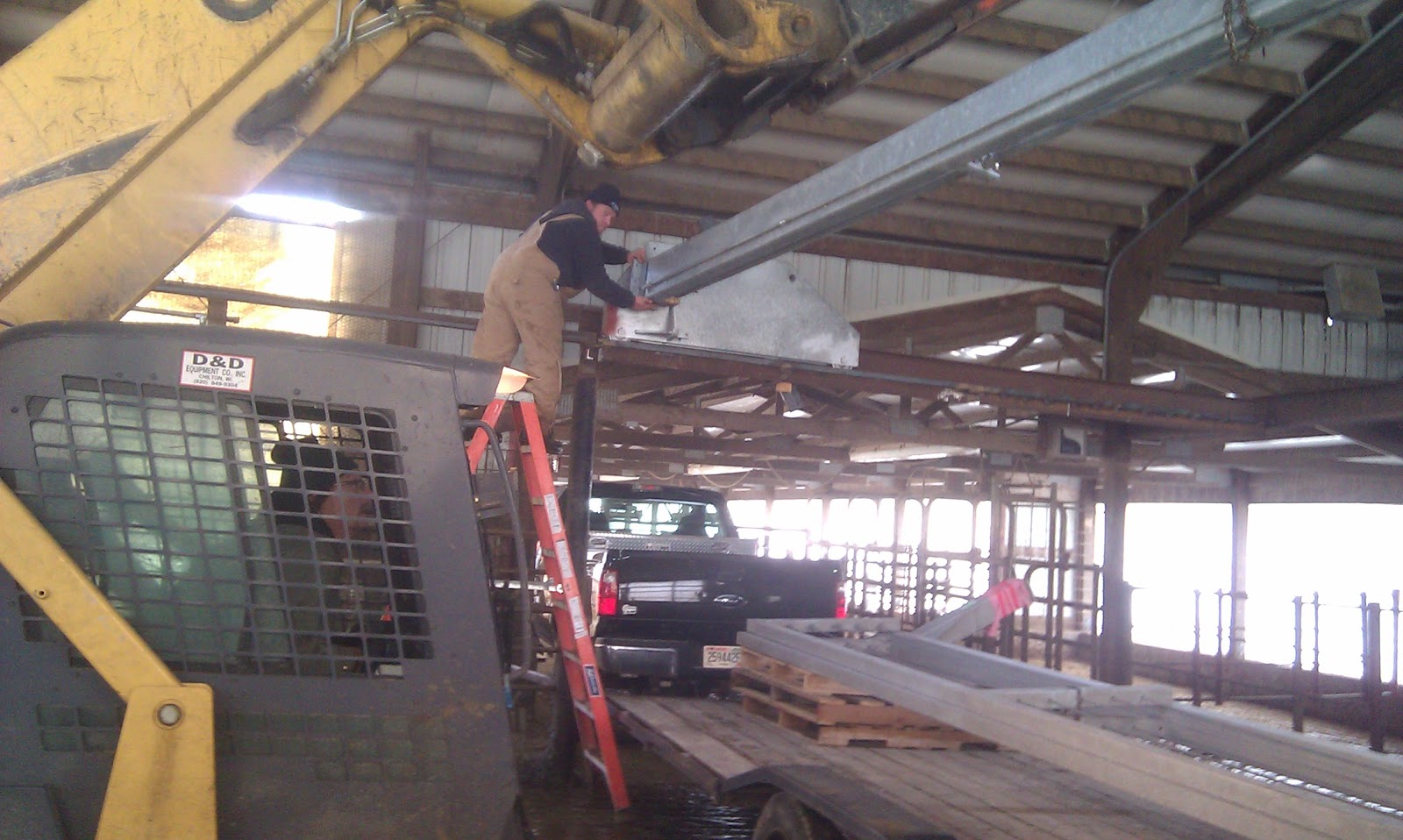
Well after 15 years, the crowd gate had begun to cause us a lot of troubles and we decided that it was time to replace it. No big deal, right? We just write a check, take the old one out and put the new one in. Sounds simple - oh but it was far from simple. The 3 days it took us to get this done each started by 7 am and we quit about 6:30 pm each night. You see what makes this less than simple is the fact we need to keep milking cows and since each shift takes 7 hours and 45 minutes from start to clean up, there isn't a lot of time to work without having to manage around the cows. Here are some pictures of our project:
This is our old crowd gate which at one point we had to work on about 8 different times in a period of 6 weeks - it was really time to make this upgrade!!
The new crowd gate was loaded from a trailer that we had to back it into the barns about 700 feet to the holding area. We used this skid steer with forks to lift the frame off the trailer and then assemble it up on the tracks. We did most of the work on the new gate in the back end of the holding area to allow us to continue to used the old gate in the area up by the parlor.
The skid steer holding the frame in place while being attached to the brackets that ride along the track.
Work being done to replace the rails while cows are still being milked. It sure would have been nice if the rails that the gate rides on would have worked for the new gate. Replacing these took lots of time and lots of grinding and welding, neither of which the cows are really comfortable with.
Removal of the old gate. This was tricky because the gate itself was wider than the holding area. We had to lift it, shift it slightly so it was crooked. And then maneuver it to the back of the holding area and take it out on the trailer like we brought ht new gate in.
Temporarilyhow we moved cows, yes I WAS the crowd gate for a few days!!
The new crowd gate in operation!! Like most thing in life, it was a challenging three days but oh so worth it in the end.
Christmas Day at Soaring Eagle in many ways is just like every other day. Since it feel on a Sunday this year, it meant that there weren't a ton of scheduled chores needing to be done and for me the day went from 4 am - 10:30 am. Just enough morning left to clean up and get to Christmas Dinner!!
Here are some videos of what Brittany and I were taking care of this morning. This first video shows us cleaning the dry cow pen. We clean the beds, scrape the alleys and then sort out any of the moms we think will have their calves in the next day or two.
Here's an up close look at the two moms delivering calves this morning.
Two Christmas bull calves were born during our shift.
Merry Christmas Everyone!! Enjoy the holidays with family and friends and God Bless all for 2012!!
Thank You to Merck Animal Health for putting together this video. It does a great job showing how todays dairy farmers are "Doing More with Less". Please click on the link below and Enjoy!
This winter, I plan to spend more time posting video and information on cows and what my sisters and I do on a daily basis in the barns. Please keep checking back and if you want to see something particular or just like what you see, feel free to comment.
It is that time of year again for us to take pause and be grateful for all the Good Lord has blessed us with. Family and friends top my list and I always try to ask for help being responsible with all God's blessings. I hope you have the opportunity to enjoy a Thanksgiving Feast with family.
If you have moment, I ask that you read something I recently came across in one of my farm magazines, Progressive Forage Grower. The author is Baxter Black, an American cowboy, poet, philosopher, former large-animal veterinarian, and radio commentator. His works include writing a column titled On the Edge of Common Sense and I found this writing fits that bill. Here goes:
Baxter Black: Thanksgiving thoughts
Not everyone has a car, owns a home, carries a cell phone, can swim, knows the 18th president and can hum “Blue Eyes Cryin’ in the Rain.”
But everyone in this country — rich or homeless, conservative, liberal, gray, green, black, white, brown or yellow — eats what we in agriculture produce; everyone, no exceptions.
Do those of you who farm and ranch think about the lives you touch? Steve Jobs invented Apple computers, Oprah Winfrey had a talk show that reached 7.4 million people five days a week, J.K. Rowling sold 450 million Harry Potter books, and 111 million watched Superbowl XLV. Talk about reaching out.
But every day, every person eats something you produce. Your contribution to their well being exceeds Hollywood, the Nobel Prize or their psychiatrist. The public’s dependence on your ability to keep them fed is deeper than their need to text, jog, work, play golf or go to school.
You are more essential to their lives than their bookie, their broker, their drug dealer, their teacher, their boss or even their best friend.
This week we celebrate the Thanksgiving holiday. It’s still a real holiday — you can tell because most of the work force gets the day off. I think of it as a time when we thank God for the blessings we have been given. Usually the Thanksgiving table is covered with food — food that we in agriculture produced.
Even the needy in soup kitchens, home-alone bachelors, single mothers, on-duty soldiers and orbiting astronauts will eat something we grew; a piece of ham, canned peas, a drumstick, a Happy Meal or pumpkin pie. Regardless of what is on their plate, it started in some farmer’s pasture or plowed field.
I don’t mean to be boastful. I don’t even expect the average urban Thanksgiving diner to remember the farmer’s contribution to their day. Many praises will fall upon the one who cooked the meal.
That is due, but without mentioning the farmers who grow it is like praising the painter of the bridge while the man who designed and constructed it, stands in the shadows.
It is common to hear that farming is a “noble calling.” That is flattering but its importance is much more profound. I agree that what we who work the land do is noble, but more, it is as vital to their lives as air and water.
What they eat is the gift of our labors, and somewhere down deep as they sit down to Thanksgiving dinner Thursday, they might conjure up a picture of a farmer leaning on a hoe or a cowboy on a horse. That thought might just be the connection that helps them understand where their food comes from: real people.
Happy Thanksgiving to all! May the tryptophan in the turkey not cause you to dose off while the Packers are beating the Lions on their way to 11-0! Go Pack Go!!
As Thanksgiving approaches it seems appropriate to share a great video regarding food production! Thank you Paul Harvey for the kind words. It sums of the pride I have to be part of creating healthy, wholesome food for the world!!
The past 30 days have been SUPER busy. I'm so very happy to say that on Tuesday, October 25th we tossed the last of the tires on a feed pile, covering the high moisture corn which will be fed to the cows over the coming year. Here are some facts about our high moisture corn pile:
- We harvested 180 acres of corn for grain, using a combine to take just the kernels off the cob. The average yield early in the season was about 185 bushel to the acre, however some terrible winds dropped the yields in some fields to about 160 bushel per acre from corn stalks braking off, making it impossible for the combine to harvest.
- Taking an average yield of 160 bushel per acre, off of 180 acres, puts the total corn harvested and stored on farm at 28,800 bushel. Today, corn traded on the market at $6.50 per bushel. Not having a feed bill to the tune of $187,200 JUST FOR CORN, makes all the hard work of growing our own crops worth it. It also makes us grateful for being provided with a good growing season, allowing us to take some corn for grain. During a poor crop year, we don't have that luxury.
- There were 6 of us out pulling plastic and tossing tires on the pile on Tuesday. I challenged the group to come up with a guess to the number of kernels of corn on the pile. Guesses ranged from 4 billion to 6 trillion. Based on "Yahoo Answers", there are 72,800 kernels in a bushel of corn, so a rough estimate is that we combined, ground and stored 2,096,440,000 kernels of corn. That's a tough number to read - it's just over 2 billion kernels.
- When we plant corn, we plant about 39,000 seeds per acre. On the 180 acres of corn that we harvested for grain, we would have planted 7,020,000 seeds, with a return over 2 billion kernels or a return of nearly 300 kernels for every one planted! To bad the stock market can't provide that!!!
Anyway, here are some videos of the process we go through once all those seeds get back to the farm.
The weather the past weeks has been AMAZING!! We have had temps in the 70's which is unseasonably warm for us this time of the year. Last week one day, I had to take wheat seed to a field of ours about 7 miles from the farm. While it could be said that the tractor I had to drive was far from comfortable (it's a very old Farmall 350), the trip was enjoyable none-the-less. The views along the country roads were breathtaking with the sun shining and showing off the fall colors. Roundtrip it probably took me a solid hour to get to the field and back and that probably ranked right up there with one of the best hours of the week!
This year, we harvested about 750 acres of corn for silage. September was particularly busy since while we were filling our 2 existing bunkers, we were also pressing to get a new feed storage pad built. In addition to hiring an engineer to design the pad, we needed to submit our plans to the DNR and get their approval.
The above picture was taken on a Friday, September 16th. You can see the large earth movers on the left side of the mirror - they were working on building our vegetative treatment area. This is a 5 acre piece of land that will act as a buffer should any nutrients run off the feed storage area. The large rectangular piece to the right of the mirror is undergoing final grading and where 4" of asphalt was poured the following week.
This next video was taken the following week when the silage pad was complete. My nephew's Austin and Nate found this to be a great place to run with their RipSticks. Unfortunately, they only had a few days before we started putting silage on the pad.
This video was taken from the pack tractor as we were putting feed on the new silage pad.
The overall size of this pile is 120' x 275'. In all it holds about 5800 ton of corn silage off of 250 acres. It took this group (plus 4 others not pictured) about 2 hours to roll out the plastic and lay out about 2400 tires on the pile.
The past few weeks have been VERY full...until a rainstorm last weekend that dropped 3 inches of rain in our neighborhood. That brought things to a screeching halt. We still have 285 acres of our own corn silage to put up and some of our uncles as well. That will be followed by manure applications for next years crops, a cutting of 80 acres of oatlage and harvesting 170 acres of high moisture corn. So with all that's left to do before frost and freezing temperatures, it's no wonder that the past few days we've been trying endlessly to make some progress with our corn harvest. It has meant several trucks getting stuck, needing to have a tractor and person in the field to pull them out and of course a lot of mud...that's where this is going...
You see we live in a land of plenty, but there still seems to be many people out there who want to enjoy highly nutritious dairy and beef products, but without ever encountering mud, odor, traffic...you get my drift. As far as I know the only way possible to get those products without those added inconveniences is to ship the cows out of the US - and I'm not sure that I want my food to be imported.
My frustration today stems from a visit by the town road supervisor. So we admittedly were tracking mud onto the road, but we also had a tractor with a scraper and a sweeper mounted on it to use intermittently to clear off the roads. Apparently we were doing a good enough job since he directed us to put a person on that tractor to continuously clean off those roads and if that didn't get it clean enough, they would order the fire department out to wash down the road. So, that was my job for the afternoon...I drove back and forth on the 1/8 mile stretch of road, scraping and sweeping, sweeping and scraping. We eventually did finish that field. I even continued sweeping when it started drizzling but opted to duck in the truck for about 5 minutes when it hailed. For about 30 minutes after all our equipment pulled out, I continued in the rain and wind to make sure our town road supervisor would be satisfied (he did drive by just as the hail started so he better not ever say we didn't try). When I finally, drove the tractor the 4 miles back to the farm (in the rain and by this time I was shivering uncontrollably) the road was clear of all debris.
It would have been so much easier to have taken a day off today and waited for things to dry out, however time is not on our side. And while I'm sorry to have such a negative attitude in today's post, I did feel it was important to remind folks that we do the best we can, but sometime we get pressured into working in less than ideal conditions and the result may be mud on the roads. But in the end we should all be grateful that we live in the land of plenty and are blessed with so very much. I probably wouldn't have reacted this way if we didn't already try so hard to keep neighbors happy. You see, we sent out 90 car washed to those who live near the fields we operate just a few weeks ago, asking them for their patience. We also bought that tractor I used today with the blade and sweeper specifically for this purpose and take great care to put out orange warning cones in situations like this. In the end though, one persons complaint and lack of understanding made a tough day even worse!!
Sorry no pictures, but I was too wet to dig my camera phone out of my pocket. More to come soon...I promise!!!
For the past several years, we have worked wheat into our crop rotation. The wheat that is harvested is sold to our local coop and the straw that remains is baled off the field to fill our bedding need for the baby calves. This year we hauled over 600 bales off 108 acres - which is a pretty solid harvest. The following videos show us hauling those bales off the field and back to the farm.
Kelly and Bernie both have some mad skidsteer driving skills!!